

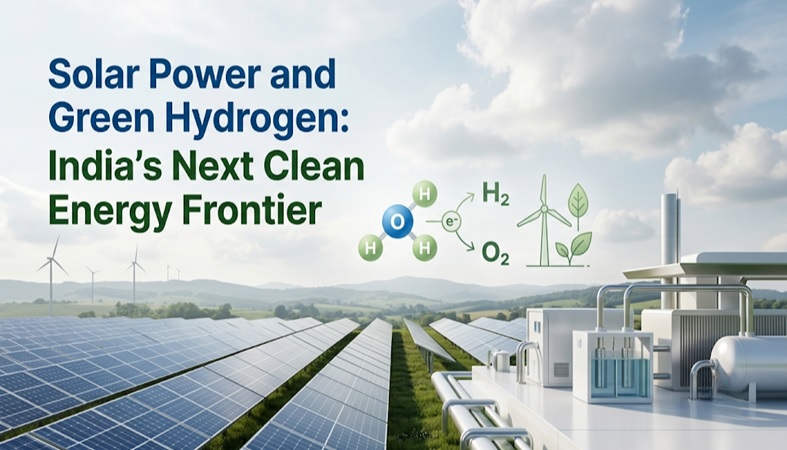
India’s clean energy story keeps building momentum, and one of the most interesting developments right now is how solar power is feeding into hydrogen production. As of mid 2026, India’s installed solar capacity has crossed 164 GW, a massive jump from just 2.8 GW back in 2014. But solar alone can’t solve everything, especially when it comes to storing energy for use around the clock. That’s where green hydrogen enters the picture.
Green hydrogen is essentially hydrogen produced by splitting water using electricity from renewable sources like solar. Run that electricity through an electrolyser, and you get clean hydrogen with none of the carbon baggage that comes from conventional production methods.
Where the Technology Stands
Electrolyser efficiency has improved a lot, with some of the newer systems converting solar electricity to hydrogen at close to 80 percent efficiency. Research institutions like IIT Madras are also working on photocatalytic water splitting, a method that uses sunlight directly rather than going through an electricity conversion step first. Concentrated solar hydrogen systems are another avenue being explored, using intense solar heat to drive the water splitting process thermochemically.
India’s Green Hydrogen Mission, Where Things Actually Are
Launched in January 2023 with a budget outlay of ₹19,744 crore, the National Green Hydrogen Mission set an ambitious target of 5 million tonnes of annual green hydrogen production by 2030. The honest picture in 2026 is that progress has been slower than hoped. By February 2026, India had commissioned only around 8,000 tonnes per year of green hydrogen capacity, a small fraction of the eventual goal. That said, the groundwork is expanding. Around 3,000 MW of electrolyser manufacturing capacity has been awarded to companies under the mission, alongside pilot projects across steel, ports, and transportation.
The Real Challenges
Cost remains the biggest hurdle, with green hydrogen still more expensive than fossil fuel alternatives, though prices are expected to fall meaningfully as electrolyser manufacturing scales up domestically. Infrastructure for storage and transport is still being built out, and water availability for electrolysis needs careful planning in water-stressed regions. Safety standards are also being developed as adoption grows.
Where This Is Headed
Despite the slower-than-expected pace, the direction is clear. As solar costs keep falling and electrolyser technology matures, the pairing of solar and hydrogen is likely to play a real role in decarbonising sectors like steel, shipping, and heavy transport that are hard to electrify directly.
Waaree, India’s largest solar panel manufacturer with over 25.8 GW in manufacturing capacity, continues to expand its role in this space. Its high-efficiency solar modules are well-suited for powering electrolysis, and its experience with large-scale solar projects positions the company as a strong partner for the solar hydrogen installations that will shape India’s energy future.